 Sparkfi
 combines savings, collateral-backed borrowing and liquidity allocation in distinct Spark products.
Last updated:
Sparkfi combines Spark Savings, SparkLend and the Spark Liquidity Layer to connect savings deposits, collateral-backed loans and managed capital allocation. Savings products package yield into assets such as sUSDS and spUSDC. SparkLend lets users supply assets or borrow against collateral. The Liquidity Layer moves capital between approved venues under governance-set limits. These products share a connection to Sky ecosystem liquidity, while serving different purposes and exposing users to different financial risks.
Key takeaway: Spark Savings offers yield exposure, SparkLend links credit to collateral and the Liquidity Layer allocates capital within governance-set limits.
A shared connection to Sky liquidity
Sky liquidity connects Spark’s savings products, lending markets and allocation infrastructure, although each product uses that connection through a different mechanism. Spark borrows from Sky’s stablecoin reserves and allocates capital across decentralized finance, centralized finance and real-world assets. SparkLend receives stablecoin liquidity directly from Sky.
A common funding relationship doesn’t make balances interchangeable: savings tokens, supplied assets and loan debt represent different positions, each with its own exposure.
Savings balances, supplied assets and loan debt
Spark Savings provides access to yield through savings products, while SparkLend supports supplying assets and taking loans against eligible collateral. Holding a savings token and supplying an asset to the money market are different uses of capital. SparkLend suppliers share interest paid by borrowers, while a savings token’s yield depends on its vault’s yield source. Supplying assets doesn’t require taking a loan, and borrowing introduces obligations that a supply-only position doesn’t have.
The Spark Liquidity Layer, or SLL, manages allocations rather than creating a personal borrowing position. It can place liquidity into lending markets or vaults and move it between approved destinations. Its relationship to a depositor is through the products and venues that it supports. A lending balance, savings token and allocation limit therefore describe different objects; their displayed amounts shouldn’t be read as equivalent measures of available credit.
Savings assets and allocation exposure
Spark Savings includes products such as sUSDS and spUSDC, which package yield into assets that users can hold. Spark’s savings offering lists USDC, USDT, PYUSD, USDS, USDG and ETH among supported assets. That product-family list doesn’t establish that every asset is available in every vault or on every network. The selected savings product determines the relevant asset and access conditions.
sUSDS earns the Sky Savings Rate, which Sky Governance sets. spUSDC is a share token for a Spark Savings V2 vault fully backed by USDS. That vault earns yield through the SLL, with rates managed by Spark Governance. Spark allocates capital across lending, institutional financing and real-world asset strategies, with liquidity infrastructure supporting access to funds. These allocations make the underlying markets and counterparties relevant to Spark Savings V2 vaults. A tokenized balance doesn’t remove those dependencies. Comparing savings options therefore requires the actual vault terms, including its supported asset, return mechanism and redemption conditions, rather than assuming one uniform arrangement across the product family.
Borrowing power and liquidation exposure
SparkLend is a permissionless money market where eligible collateral supports loans within the parameters of the active lending market. Supply caps restrict how much of an asset the market accepts. Borrow caps restrict how much can be borrowed. Sky Governance configures these limits, and cap automation can adjust them with market depth. Collateral eligibility and borrowing capacity remain asset-specific. A loan’s health factor measures collateral coverage against its liquidation threshold. For one collateral asset, it equals collateral value multiplied by the applicable liquidation threshold, divided by debt value.
A SparkLend position becomes eligible for liquidation when its health factor falls below 1. Falling collateral prices or growing debt can reduce that ratio.
In a hypothetical comparison, a savings-token holder has no SparkLend loan, while a borrower has one eligible collateral asset valued at $12,684, debt valued at $6,342 and a liquidation threshold of 76%. Those valuations and the threshold are illustrative inputs, not live market parameters. The borrower’s health factor is ($12,684 × 0.76) ÷ $6,342 = 1.52, placing the loan above the liquidation boundary at those valuations. The savings holding has no SparkLend loan to liquidate in this comparison, although its underlying savings exposure remains. The borrower holds borrowed funds alongside collateral-backed debt.
A lower collateral valuation or higher debt reduces the health factor, bringing the loan closer to liquidation.
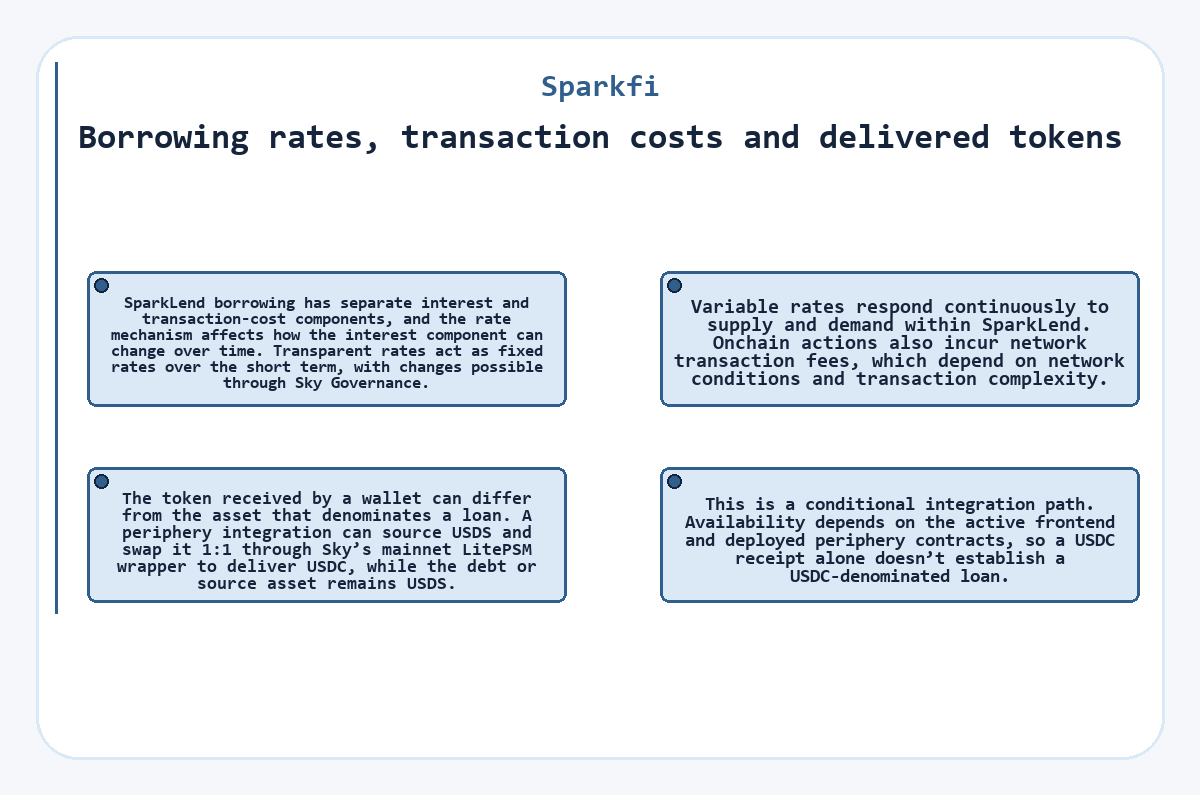
Borrowing rates, transaction costs and delivered tokens
SparkLend borrowing has separate interest and transaction-cost components, and the rate mechanism affects how the interest component can change over time. Transparent rates act as fixed rates over the short term, with changes possible through Sky Governance. Variable rates respond continuously to supply and demand within SparkLend. Onchain actions also incur network transaction fees, which depend on network conditions and transaction complexity.
The token received by a wallet can differ from the asset that denominates a loan. A periphery integration can source USDS and swap it 1:1 through Sky’s mainnet LitePSM wrapper to deliver USDC, while the debt or source asset remains USDS. This is a conditional integration path. Availability depends on the active frontend and deployed periphery contracts, so a USDC receipt alone doesn’t establish a USDC-denominated loan.
Liquidity allocation within approved venues
The Spark Liquidity Layer is a non-custodial capital allocator whose automation operates within governance-configured permissions, rate limits and applicable slippage checks. SLL automation can allocate capital only to governance-approved venues. Each supported controller operation uses a rate-limit key associated with its action and relevant target. An unconfigured venue cannot receive an allocation through that operation.
Sparkfi: Savings vs SparkLend vs Liquidity Layer
- Borrowing rates, transaction costs and delivered tokens
- Liquidity allocation within approved venues
- Network coverage and retired lending deployments
Rate limits combine a maximum available amount with regeneration over time. The ceiling bounds the amount available at once, while the regeneration rate controls sustained allocation capacity. Integration-specific slippage constraints add another boundary. OTC activity uses dedicated buffer contracts, with only one outstanding swap allowed per approved exchange until the previous swap is claimed back under the applicable conditions.
Supported integrations include SparkLend and Aave v3 lending markets, ERC-4626 vaults including Spark-curated Morpho vaults and selected stablecoin pools. ERC-4626 defines a standard for tokenized vaults. Supported Curve pools are restricted to 1:1 stablecoin pools. Supported Uniswap V4 pools are restricted to 1:1 hookless pools with governance-configured tick limits. Bridge integrations include Circle CCTP for USDC and LayerZero OFT routes configured per asset. Integration support remains separate from approval of a particular destination.
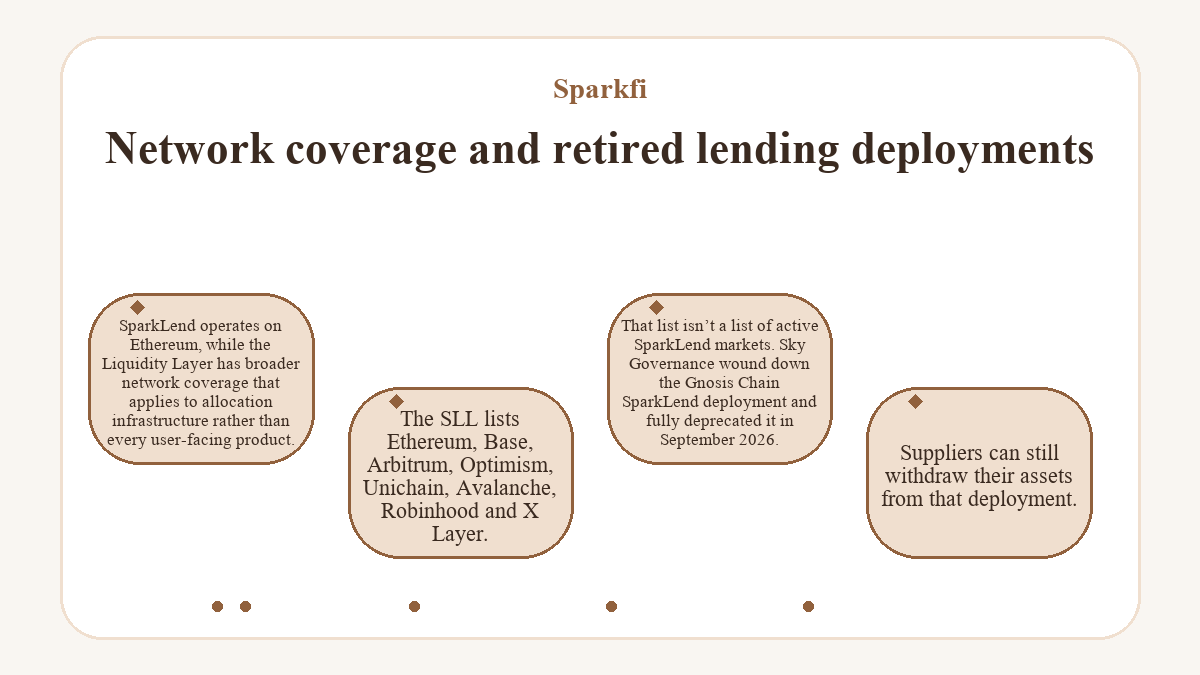
Network coverage and retired lending deployments
SparkLend operates on Ethereum, while the Liquidity Layer has broader network coverage that applies to allocation infrastructure rather than every user-facing product. The SLL lists Ethereum, Base, Arbitrum, Optimism, Unichain, Avalanche, Robinhood and X Layer. That list isn’t a list of active SparkLend markets. Sky Governance wound down the Gnosis Chain SparkLend deployment and fully deprecated it in September 2026. Suppliers can still withdraw their assets from that deployment.
Risk controls and the limits of liquidity support
Liquidity support can come from the SLL, which can inject capital into a SparkLend reserve, Spark-curated Morpho vault or Spark Savings vault. This can support withdrawals while liquidations or redemptions settle through their normal channels. The support remains bounded by approved venues, rate limits and governance-set risk parameters. If a potential loss affects a Spark Savings V2 vault, Spark can activate recovery mode and temporarily halt its withdrawals.
Operational controls also address compromised automation. The SLL threat model assumes that a relayer can be fully compromised. Contract permissions restrict capital movements, while applicable slippage limits and emergency controls bound exposure. A
FREEZER
can revoke a compromised
RELAYER
. Where the freezable proxy variant is deployed, it can also detach a compromised controller. Governance can then reassign or reissue relayer credentials.
Monitoring covers collateral valuations, oracle liveness and utilization changes, alongside borrower positions that approach liquidation thresholds. These controls address different failure conditions. Their usefulness remains tied to configured limits, functioning integrations and the response to detected stress.
Additional borrowing, token and institutional functions
Spark’s broader product suite includes Isolated Markets, SPK, Swap and separate points and rewards programs. SPK is used for signaling votes on Snapshot. Staking SPK through Symbiotic earns Spark Points and carries slashing risk. Unstaking queues a withdrawal that becomes claimable after two to four weeks, depending on epoch timing. Isolated Markets use Morpho’s independent lending markets, each pairing one collateral asset with one loan asset under its own oracle, liquidation parameters and interest-rate model. SparkLend’s collateral parameters and network history shouldn’t be assumed to govern that separate product. The SPK airdrop has concluded, and airdropped tokens can no longer be claimed.
Institutional offerings include custody-integrated credit and Liquidity as a Service for stablecoin ecosystems. Exchanges, custodians, fintechs and onchain applications can integrate Spark’s savings, borrowing and liquidity products. Integration access and institutional credit terms belong to those arrangements. A borrowing decision therefore starts with the specific offering and debt terms, while a savings decision starts with the selected product and asset.
Sparkfi FAQs
Does SparkLend redeploy supplied collateral into external investment strategies?
Collateral supplied to SparkLend reserves stays in the reserve and isn’t redeployed into external strategies. The Spark Liquidity Layer separately allocates capital across approved venues, including external lending markets and vaults. Supplying collateral to SparkLend therefore doesn’t give it the same allocation path as capital managed by the SLL.
Which price feeds does SparkLend use when an oracle becomes unavailable?
SparkLend’s pricing system uses RedStone, Chainlink and Chronicle feeds, with fallback behavior based on their validity. When all three provide valid, non-stale values, it uses the median. With two valid feeds, it uses their average. A single-feed fallback also exists, so the availability of multiple oracle providers doesn’t mean every price always incorporates three feeds.
Can Bitcoin collateral still use SparkLend’s BTC E-Mode?
SparkLend’s BTC E-Mode was removed, and remaining positions in that category were force-liquidated on June 8, 2026. ETH E-Mode collateral is limited to wstETH and rETH. Other collateral use depends on the active market’s asset listing and risk parameters; the removal of a specific efficiency-mode category shouldn’t be treated as a universal rule for every Spark product.
When can a liquidation cover all of a SparkLend loan?
A liquidation call can cover up to 100% of a SparkLend position’s debt when its health factor is at or below 0.95. Below 1 but above 0.95, a call can cover up to 50%. These percentages describe debt coverage per liquidation call. The collateral transferred depends on covered debt, oracle prices and the applicable liquidation bonus.
Why can a collateral peg deviation halt new SparkLend borrowing?
SparkLend’s peg-ratio killswitch can halt new borrowing when a monitored asset’s market price deviates beyond its configured threshold. It applies to collateral priced through hardcoded or exchange-rate relationships. The mechanism compares market value with the underlying asset to limit borrowing against a distressed asset at an outdated reference value. The deviation threshold is specific to the asset.
Is the SLL automation wallet a custodian for allocated funds?
The SLL’s 1-of-2 SAFE is an automation smart wallet and doesn’t custody the funds that it allocates. It supports transaction batching and rotation of hot-wallet keys. Its allocation permissions remain restricted to governance-approved venues and configured limits. The wallet’s signer arrangement doesn’t grant unrestricted authority over capital movement.