 Sparkfi
Sparkfi’s SparkLend collateral toggle changes borrowing support without withdrawing supplied assets.
Last updated:
Sparkfi’s SparkLend collateral toggle determines which supplied assets back a loan. Switching an eligible asset off removes its collateral contribution without withdrawing the supply balance or repaying debt. A withdrawal reduces the supplied balance and requires available reserve liquidity. If the asset backs outstanding borrowing, the position must also satisfy the protocol’s health checks after the withdrawal.
The setting belongs to supplied asset rows in My portfolio. Borrowing, repayment and withdrawal change different parts of the position. SparkLend’s active lending deployment is on Ethereum; Spark Savings and Morpho-powered Isolated Markets use separate mechanisms.
How does the collateral toggle differ from a withdrawal?
The collateral toggle changes an asset’s role in a SparkLend position, while a withdrawal reduces its supplied balance. Switching collateral off excludes that asset from the backing for the position’s debt. The asset remains supplied and can continue earning lending interest. Withdrawing returns underlying assets and reduces the supply claim. A partial withdrawal can leave the remaining balance enabled as collateral, provided the remaining position passes validation.
The toggle applies to the selected supplied asset’s balance. It doesn’t select a smaller amount to exclude.
Supplied balances with collateral enabled or disabled
A supplied balance can earn interest whether or not it contributes to borrowing support, because lending participation and collateral use describe different properties of the same supply position.
Enabled collateral
Enabled assets contribute to the collateral that the protocol uses to assess borrowing and liquidation exposure. Eligible supplied balances can support a combined SparkLend position, subject to their asset parameters and any applicable mode restrictions, while the amount available to borrow also depends on liquidity in the selected market for the requested loan asset. An enabled setting doesn’t create debt by itself. Borrowing is a separate operation.
Disabled collateral
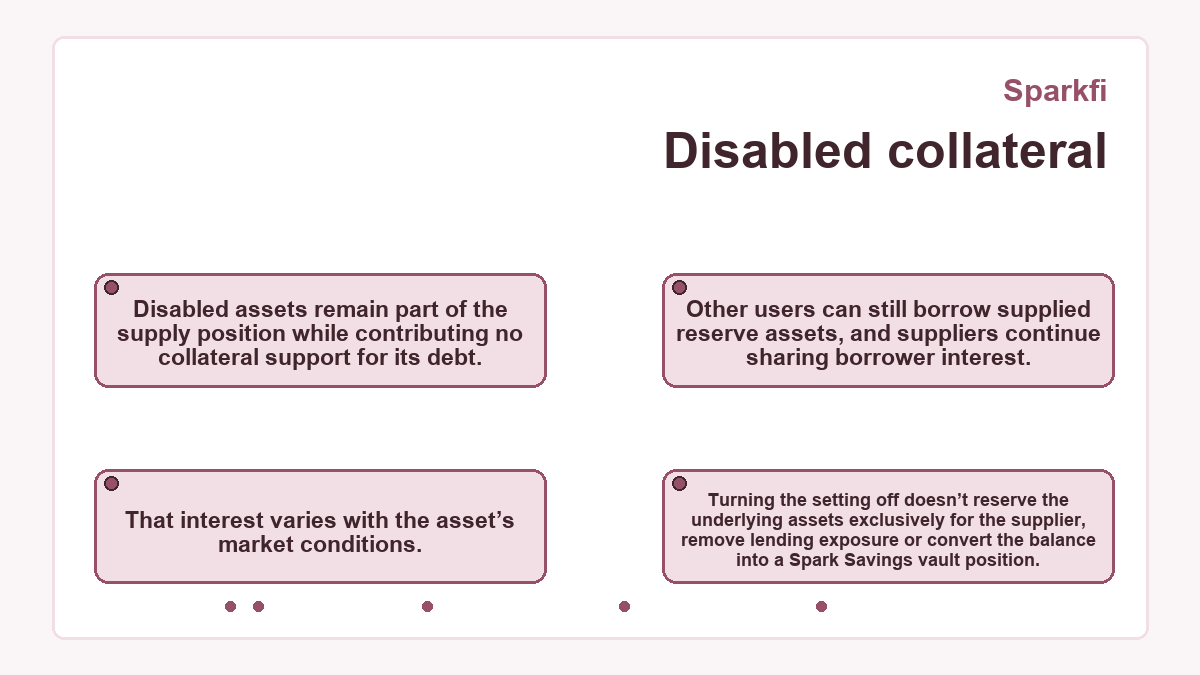
Disabled assets remain part of the supply position while contributing no collateral support for its debt. Other users can still borrow supplied reserve assets, and suppliers continue sharing borrower interest. That interest varies with the asset’s market conditions. Turning the setting off doesn’t reserve the underlying assets exclusively for the supplier, remove lending exposure or convert the balance into a Spark Savings vault position.
Health factor after removing collateral
SparkLend positions become eligible for liquidation when their health factor falls below 1. The collateral-disable operation validates the position after excluding the selected asset. A change that would fail the health-factor check reverts, leaving that collateral setting unchanged.
The health factor divides liquidation-threshold-adjusted collateral value by debt value. For multiple collateral types, each enabled asset contributes according to its balance, the protocol’s valuation and its applicable liquidation threshold. Removing a contributing asset reduces the backing while leaving the debt outstanding. Prices and accrued borrowing interest can also change the ratio after a permitted adjustment. Passing the transaction’s check establishes acceptance under that state; it doesn’t hold the ratio constant afterward.
Loan-to-value limits and liquidation thresholds
Loan-to-value, or LTV, limits borrowing against collateral, while the liquidation threshold determines when existing debt becomes liquidatable. A reduction in borrowing power doesn’t automatically mean an existing loan has crossed its liquidation boundary. Sky Governance can reduce an asset’s borrowing power to 0% while preserving existing borrowers’ positions. Consequently, an asset’s maximum borrowing contribution and its contribution to liquidation protection can differ. Neither the available borrowing amount nor the supply balance alone establishes how much collateral can be withdrawn.
Asset eligibility and the scope of the setting
Collateral eligibility belongs to the selected reserve and the position’s configuration; the presence of a Supply action doesn’t establish permission to enable collateral. SparkLend exposes separate asset statuses for supplying, collateral use and borrowing. The collateral-toggle validation requires a nonzero supplied balance and an active, unpaused reserve. Enabling an asset also requires a nonzero LTV and compatibility with the position’s isolation restrictions. Governance can change asset parameters, including reducing an asset’s LTV to zero and preventing new collateral activation.
Repayment and additional collateral
Repayment reduces outstanding debt, while additional eligible collateral increases the backing that supports it. Either can change the scope for removing an existing collateral contribution, subject to the resulting position and market constraints.
Reducing the debt side
Partial repayment can improve the health factor while leaving an open borrowing position. Full repayment removes the collateral requirement associated with the debt that has been cleared. Other outstanding debts still matter. The Repay transaction overview shows remaining debt and the position’s health factor for the selected repayment. Borrowing interest accrues over time, so the debt balance can exceed the original borrowed amount. A collateral toggle doesn’t settle that interest or replace repayment.
Increasing eligible backing
Additional supply helps collateral coverage only when the asset qualifies and counts as enabled collateral. A balance that remains disabled adds no backing to the calculation. New supply also faces the reserve’s supply cap, and Isolation Mode can prevent combining collateral types. Removing an existing contribution before replacement backing counts can leave the position unable to pass validation.
Can I withdraw while an asset is still enabled as collateral?
A SparkLend asset can remain enabled as collateral during a partial withdrawal if the remaining position passes validation and the reserve has enough liquidity. There’s no universal requirement to switch the toggle off first. The withdrawal reduces the balance that supports the position, so the protocol evaluates the remaining collateral when debt is outstanding. Withdrawing the entire balance clears that asset’s collateral setting. Full removal still has to pass the applicable checks, including any constraints arising from other enabled collateral.
Zero-LTV collateral as a withdrawal edge case
Zero-LTV collateral can restrict removal of another enabled asset even when a borrower’s health factor passes its check. SparkLend applies an extra LTV check when enabled zero-LTV collateral still has a nonzero liquidation threshold. Disabling nonzero-LTV collateral then fails, even without debt. Withdrawing enabled nonzero-LTV collateral faces the same restriction when debt is outstanding. This rule is separate from the liquidation boundary. It explains why a healthy-looking position can encounter an LTV validation failure when disabling collateral or withdrawing a collateral balance.
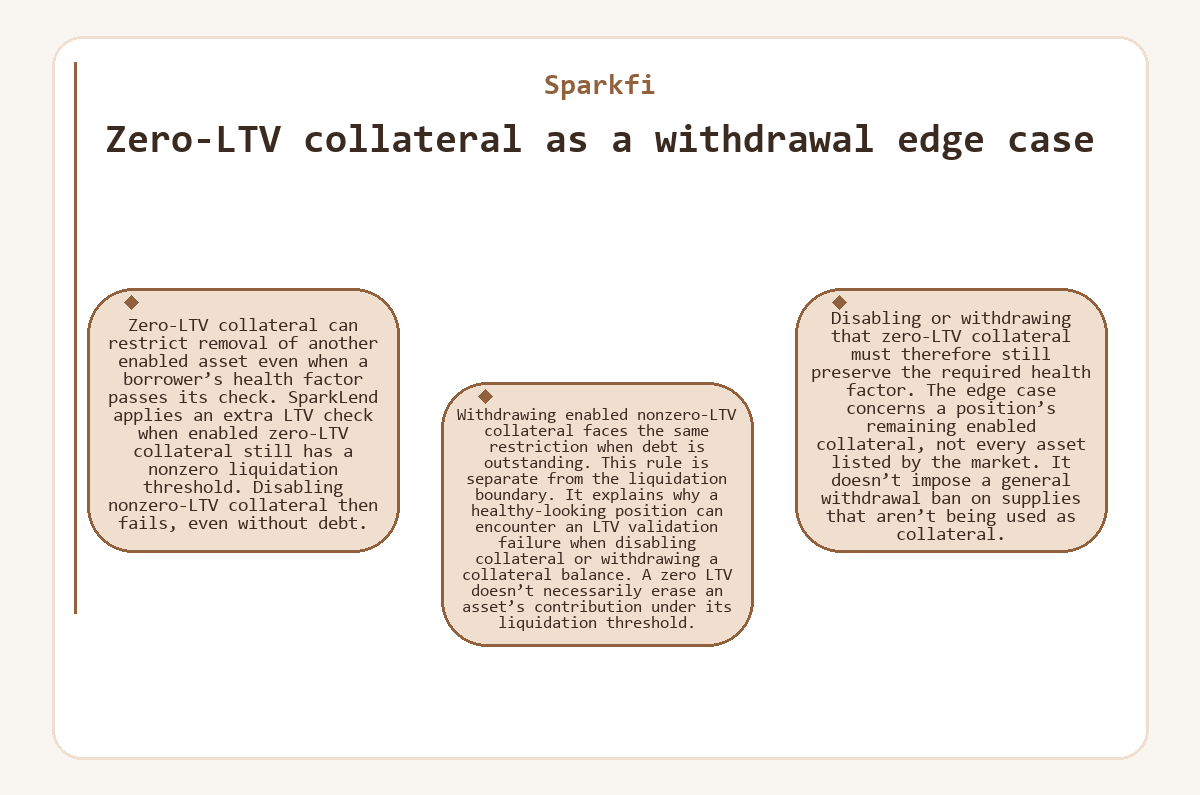
A zero LTV doesn’t necessarily erase an asset’s contribution under its liquidation threshold. Disabling or withdrawing that zero-LTV collateral must therefore still preserve the required health factor. The edge case concerns a position’s remaining enabled collateral, not every asset listed by the market. It doesn’t impose a general withdrawal ban on supplies that aren’t being used as collateral.
Reserve liquidity and allocation support
Available reserve liquidity limits withdrawals independently of collateral coverage. A position can pass its health checks while the reserve lacks enough underlying assets to fulfill the requested amount. Supplied assets participate in a shared lending reserve, and borrowing reduces the liquidity available for withdrawal. The supply claim and immediately available underlying balance can therefore differ. Switching collateral off changes borrowing support without replenishing the reserve’s cash.
The Spark Liquidity Layer can move stablecoin capital into SparkLend reserves as utilization and available inventory change. It can also support depositor withdrawals while liquidations or redemptions settle. Governance-approved venues, rate limits and risk parameters bound that support. Allocation infrastructure doesn’t remove the need for an individual withdrawal to find enough liquidity in its selected reserve.
Savings liquidity intents handle certain Spark Savings vault withdrawals. SparkLend uses its reserve withdrawal function to redeem a supply claim.
Isolation Mode and Morpho Isolated Markets
Isolation Mode restricts collateral combinations within SparkLend, while Morpho-powered Isolated Markets organize loans into separate collateral-and-loan pairs. Similar names describe different borrowing structures, with different limits on changing collateral.
SparkLend’s collateral restriction
An asset configured for Isolation Mode must be the position’s sole collateral type when it’s enabled as collateral. Other supplied assets can still earn interest, although they can’t simultaneously provide collateral backing. The isolated asset also has a debt ceiling. Disabling its collateral setting is part of leaving isolation, and the position must still pass SparkLend’s collateral validation.
Morpho’s fixed collateral pair
A Morpho Isolated Market fixes its collateral token, loan token, oracle, liquidation LTV and interest rate model at creation. Changing a SparkLend toggle doesn’t change those market definitions or move a SparkLend position into Morpho. A market with another collateral token constitutes a different market.
Choosing a change that matches the intended outcome
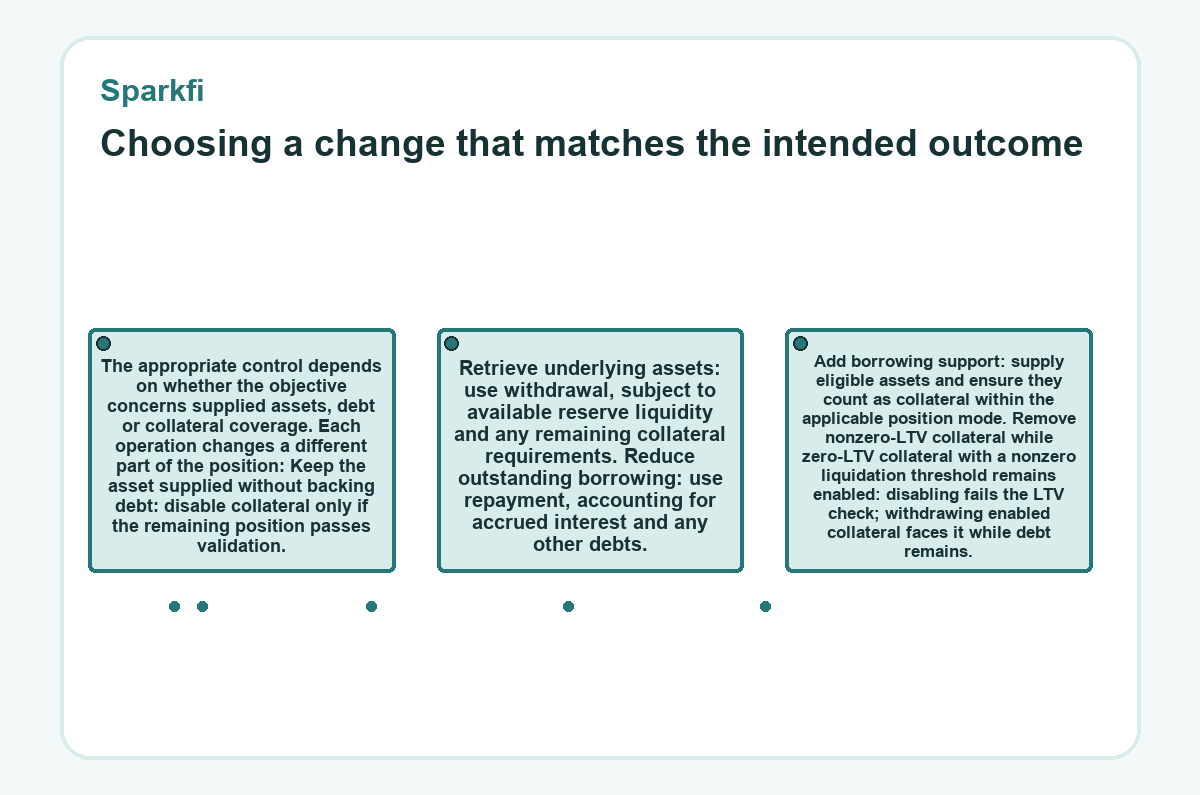
The appropriate control depends on whether the objective concerns supplied assets, debt or collateral coverage. Each operation changes a different part of the position:
- Keep the asset supplied without backing debt: disable collateral only if the remaining position passes validation.
- Retrieve underlying assets: use withdrawal, subject to available reserve liquidity and any remaining collateral requirements.
- Reduce outstanding borrowing: use repayment, accounting for accrued interest and any other debts.
- Add borrowing support: supply eligible assets and ensure they count as collateral within the applicable position mode.
- Remove nonzero-LTV collateral while zero-LTV collateral with a nonzero liquidation threshold remains enabled: disabling fails the LTV check; withdrawing enabled collateral faces it while debt remains.
Sparkfi: questions and answers
Which tokens are needed to redeem a SparkLend supply position?
SparkLend’s spTokens represent the supply position and are needed to withdraw its underlying assets. They aren’t interchangeable with Spark Savings vault shares simply because some token names use a similar prefix. Keeping an asset supplied with collateral disabled leaves the supply claim in place. Redemption reduces that claim as the corresponding underlying assets leave the reserve.
Why is no liquidation price displayed when several collateral assets are enabled?
SparkLend doesn’t display the single-collateral current-price and liquidation-price information when a position uses more than one collateral type. The position’s health factor still measures its combined collateral coverage against debt. Different enabled assets can change in value independently, so one asset’s price alone doesn’t describe the liquidation boundary for the combined position.
What network fees apply when changing SparkLend collateral settings?
Changing a SparkLend collateral setting requires an onchain transaction and incurs the network’s transaction fee. The amount depends on network conditions and transaction complexity. A toggle, repayment and withdrawal are different operations, so a quoted fee for one doesn’t establish the total cost of several adjustments.
Does changing the collateral toggle also change E-Mode?
The collateral toggle and E-Mode are separate SparkLend settings. The toggle controls whether a supplied asset contributes to collateral, while E-Mode changes the applicable category for supported correlated assets. Changing collateral use doesn’t itself select a different E-Mode category. A proposed category change must satisfy its own eligibility and position checks; the collateral toggle can’t substitute for it.
Can suppliers still withdraw from the retired Gnosis Chain deployment?
Suppliers can still withdraw assets from SparkLend’s retired Gnosis Chain deployment. Sky Governance fully deprecated that deployment in September 2026, and its markets are frozen. Freezing prevents further supplying and borrowing while preserving withdrawals and repayments. The active SparkLend deployment is on Ethereum; the old Gnosis supply balance remains associated with its original deployment.
Do I repay USDC when a USDS-denominated loan delivers USDC?
A USDS-denominated loan remains repayable in USDS when a periphery route converts the delivered funds to USDC. That route sources USDS and swaps it 1:1 through the mainnet LitePSM wrapper. The received wallet asset and the debt denomination therefore differ. This applies only when the active interface and contracts use that route; receiving USDC alone doesn’t establish USDS debt.
Will transferring spTokens avoid the restrictions on removing collateral?
Transferring SparkLend spTokens doesn’t bypass collateral validation when they represent enabled collateral backing outstanding debt. The protocol checks the sender’s remaining position when the transfer reduces that backing. A transfer changes ownership of the supply claim; it doesn’t return the underlying assets from the reserve. It also doesn’t repay the sender’s outstanding loan.