 Sparkfi
Sparkfi savings: Yield Sources and Vault Choices
Last updated:
Sparkfi savings vaults earn yield through different mechanisms, so the deposit asset alone doesn’t identify a vault’s rate source or risk profile. Spark Savings V2 uses the Spark Liquidity Layer, while sUSDS and legacy sUSDC follow the Sky Savings Rate. stUSDS earns through a separate lending mechanism, and sDAI follows the DAI Savings Rate. Each savings token represents vault shares. Comparing yield sources, backing and withdrawal mechanics explains what similar-looking balances actually hold.
Jump to a section
The short version: Changing the deposit stablecoin doesn’t remove the common USDS backing exposure of Spark’s USD savings vaults.
Vault shares, allocation returns and rate setters
Vault shares connect a depositor’s balance to a specific yield mechanism, with rate governance determining how that mechanism translates into savings earnings. The deposit asset identifies what enters the vault. The share token identifies the claim that the holder receives. Yield sources and rate setters explain how that claim earns over time. Spark Savings combines Spark-operated vaults with Sky products, so a shared interface doesn’t imply a shared operator or identical investment exposure.
Spark V2 vaults and their backing
Stablecoin-denominated vaults
Spark Savings V2 includes spUSDC, spUSDT, spPYUSD and spUSDG, with yield generated through Spark Liquidity Layer allocations. Spark Governance manages these rates based on market conditions and underlying strategies. The token that a depositor supplies doesn’t define the full exposure that supports the savings balance. Spark Savings USD vaults have USDS backing, bringing the composition of USDS collateral into the comparison.
USDS backing also means that separate deposit currencies don’t create completely separate underlying risk. A comparison between these vaults therefore includes the yield mechanism and redemption arrangements alongside the accepted stablecoin. The selected vault’s collateral composition describes its exposure more precisely than the currency displayed in the deposit field.
ETH-denominated savings
spETH uses the Liquidity Layer for yield, with rates managed by Spark Governance. Its backing comes from Spark’s balance sheet and insurance. That arrangement differs from USDS-backed stablecoin vaults, so the stablecoin vaults’ backing structure doesn’t describe the protection that applies to spETH.
Sky savings rates, stUSDS and legacy vaults
sUSDS and the Sky Savings Rate
sUSDS gives direct exposure to the Sky Savings Rate, which Sky Governance sets. Sky Protocol borrowing fees fund that rate. Spark doesn’t control it. A rate change here reflects the Sky mechanism; Spark V2 rates have a separate governance basis.
stUSDS and SKY-collateralized lending
stUSDS lends USDS to borrowers who post SKY tokens as collateral. Sky Governance sets stUSDS’s separate rate, and its lending exposure differs from sUSDS. Potential liquidity constraints and the lack of automatic liquidations give stUSDS a different risk profile, despite the shared USDS deposit asset.
sUSDC V1 and sDAI
Legacy sUSDC accepts USDC and earns through the Sky Savings Rate. Legacy sDAI accepts DAI and earns through the DAI Savings Rate, which Sky Governance sets. The V1 label describes the older Spark USDC vault mechanism; it doesn’t make sUSDC another name for spUSDC V2. These products retain distinct share tokens and yield sources.
How does yield change the value of vault shares?
Yield accrues through a rising redemption rate, so each savings share represents a growing claim on the vault’s underlying assets as earnings accumulate. Spark Savings vault tokens follow the ERC-4626 tokenized vault standard. Yield accrual increases the assets represented by each share without increasing the share count. A share balance alone therefore doesn’t tell the holder’s underlying-asset balance. The asset equivalent of a holding follows the vault’s current share conversion. That accounting value is distinct from the liquidity available to satisfy a withdrawal.
Different vault tokens don’t have a universal one-token-to-one-asset valuation. Comparing token counts across sUSDS and spUSDC can’t establish which position has earned more. The relevant quantities are the assets represented by each holding and the change in that claim, measured in the applicable asset. A changing token price in dollars can also reflect an underlying asset’s market price, not only vault earnings.
An equal USDC rate with different yield sources
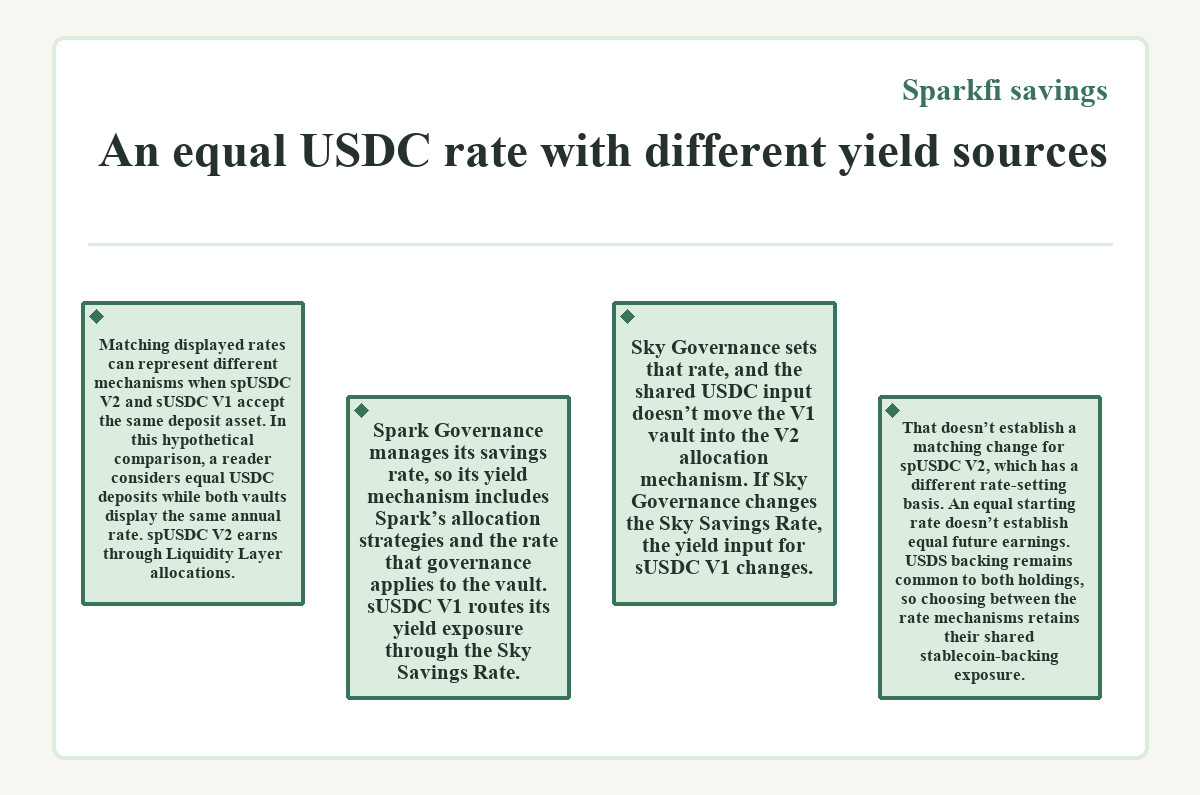
Matching displayed rates can represent different mechanisms when spUSDC V2 and sUSDC V1 accept the same deposit asset. In this hypothetical comparison, a reader considers equal USDC deposits while both vaults display the same annual rate.
spUSDC V2 earns through Liquidity Layer allocations. Spark Governance manages its savings rate, so its yield mechanism includes Spark’s allocation strategies and the rate that governance applies to the vault.
sUSDC V1 routes its yield exposure through the Sky Savings Rate. Sky Governance sets that rate, and the shared USDC input doesn’t move the V1 vault into the V2 allocation mechanism.
If Sky Governance changes the Sky Savings Rate, the yield input for sUSDC V1 changes. That doesn’t establish a matching change for spUSDC V2, which has a different rate-setting basis.
An equal starting rate doesn’t establish equal future earnings. USDS backing remains common to both holdings, so choosing between the rate mechanisms retains their shared stablecoin-backing exposure.
Allocation controls behind V2 yield
The Spark Liquidity Layer connects V2 savings yield to allocations across approved financial venues, including decentralized finance, centralized finance and real-world asset strategies. It supports several integration types, such as lending markets, tokenized vaults and stablecoin liquidity pools. Support for an integration doesn’t mean that every savings vault has exposure to it, or that every strategy carries the same risk.
The Spark Liquidity Layer restricts capital movement to governance-approved venues. Rate limits constrain how much capital can move along configured routes. Slippage checks and emergency freezing add operational controls where applicable. These restrictions bound allocator actions; they don’t remove losses that an approved investment can incur.
Configured rate limits combine a maximum amount with a regeneration rate. They constrain both immediate capital movement and how quickly capacity replenishes. Sky Governance determines the SLL’s supported networks, protocols and risk parameters. Spark Governance manages V2 savings rates. These controls govern different parts of the arrangement: permission to allocate capital and the rate applied to the savings claim.
Savings yield and SparkLend supply interest
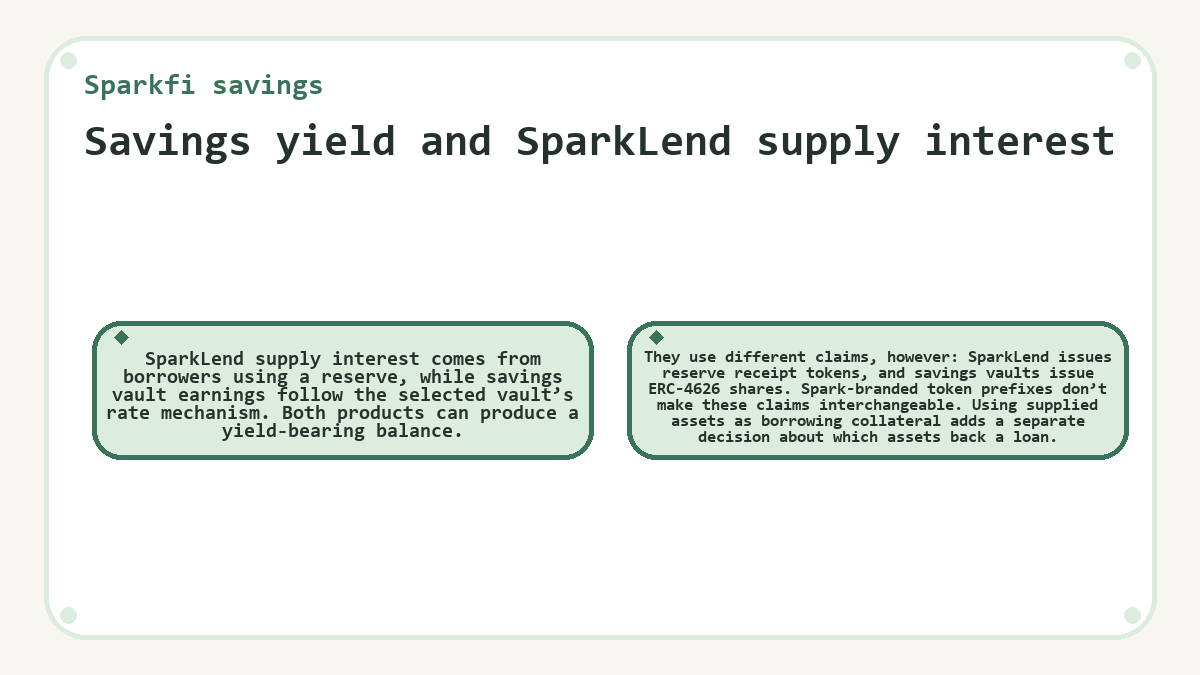
SparkLend supply interest comes from borrowers using a reserve, while savings vault earnings follow the selected vault’s rate mechanism. Both products can produce a yield-bearing balance. They use different claims, however: SparkLend issues reserve receipt tokens, and savings vaults issue ERC-4626 shares. Spark-branded token prefixes don’t make these claims interchangeable. Using supplied assets as borrowing collateral adds a separate decision about which assets back a loan.
What determines access to savings withdrawals?
Withdrawal access depends on the vault and its available liquidity, even though the savings products don’t impose scheduled lockup periods. Recovery mode can temporarily halt withdrawals during a potential loss event. stUSDS also has additional liquidity constraints.
Idle liquidity and atomic redemptions
V2 vaults hold idle liquidity for atomic redemptions, which settle through a single onchain transaction. The amount available at that moment determines whether a requested redemption fits inside that buffer. A savings rate and an idle liquidity buffer measure different things. An annualized return figure doesn’t specify how many units are immediately available for withdrawal. The Liquidity Layer can supply additional capital within its approved venues and rate limits, so liquidity support has operational boundaries.
Liquidity intents on Ethereum
Larger spUSDC and spUSDT withdrawals on Ethereum that exceed available idle liquidity can use Savings Liquidity Intents. The app submits an asynchronous request that the Liquidity Layer usually fulfills within minutes. Submission and settlement are different states, so the request itself doesn’t mean that withdrawn assets have arrived. For this route, requests can’t be cancelled in the first hour; cancellation becomes available after one hour if fulfillment is still pending.
USDS backing and the order of loss absorption
USDS-backed savings vaults share exposure to the capital structure that supports USDS, even when their accepted deposit coins differ. Junior risk capital absorbs allocation losses first. Capital that Spark holds and any external junior capital that it sources sit at equal priority within that junior layer. Sky’s surplus buffers and SKY token backstop provide subsequent support under the applicable loss-allocation rules. The existence of those layers doesn’t fix the amount that any one loss event would absorb.
Sky can mint SKY tokens to recapitalize the protocol after earlier protection layers prove insufficient. If all other relevant capital sources and token backstops are exhausted, residual losses are shared across USDS holders, including USDS-backed savings vaults. Backstops therefore reduce exposure through a defined loss-absorption structure; they don’t turn a vault share into an unconditional principal claim.
Network-specific assets and deposit conversions
Savings deployment choices determine which asset a vault accepts on a network, without changing the distinction between its deposit currency and yield source. spUSDC accepts USDC on Ethereum and X Layer. spUSDT accepts native USDT on Ethereum, while its Arbitrum and X Layer deployments accept USDT0. spUSDG accepts USDG on Robinhood Chain. The Liquidity Layer’s wider network coverage doesn’t establish universal availability for each individual vault.
Depositing a token into its corresponding native vault has no deposit slippage. That condition covers the asset-to-vault relationship, including USDC into spUSDC and USDT into the native Spark USDT vault. A route that first exchanges another asset includes a conversion, so the native-deposit rule alone doesn’t establish its output. Network fees and the redemption method remain separate dimensions of the comparison.
Rate changes and the units of comparison
A rate quoted at one moment can’t determine cumulative earnings without the period that it applies to. Changes in a V2 rate reflect Spark Governance’s settings and allocation strategies. Changes in the Sky Savings Rate follow Sky Governance. Their rate setters differ even when the interface presents the figures in the same annual format.
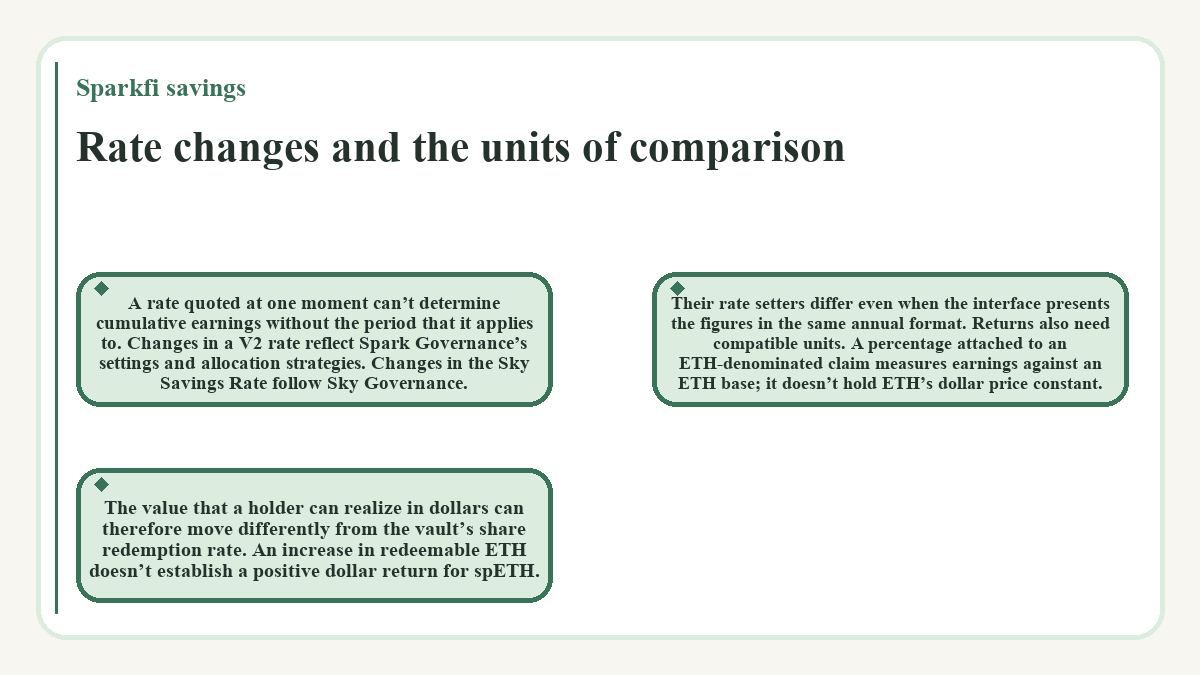
Returns also need compatible units. A percentage attached to an ETH-denominated claim measures earnings against an ETH base; it doesn’t hold ETH’s dollar price constant. The value that a holder can realize in dollars can therefore move differently from the vault’s share redemption rate. An increase in redeemable ETH doesn’t establish a positive dollar return for spETH.
Sparkfi savings FAQ
Can I keep using sUSDC V1 without moving to a V2 vault?
Existing sUSDC V1 holdings can remain in the legacy vault, so migration to V2 isn’t compulsory. Keeping V1 preserves its Sky Savings Rate mechanism. Moving to spUSDC V2 changes the vault token and yield mechanism, even though both accept USDC.
Does transferring a savings token interrupt its yield?
Transferring a savings vault token doesn’t, by itself, interrupt the yield that its shares accrue. Spark Savings vault tokens are transferable, and their claim on underlying assets continues to reflect the vault’s redemption rate wherever they’re held. The recipient holds the transferred savings claim. This transfer doesn’t move the position into a different vault or substitute a new rate-setting mechanism.
Do ERC-4626 savings shares work with every DeFi application?
Compatibility depends on whether an application supports the specific savings token. ERC-4626 gives the vault a standard assets-and-shares interface, and its tokens also follow ERC-20 conventions. Those standards make integration possible; they don’t require every lending market or application to accept every token. Acceptance of the specific token and deployment remains the relevant compatibility condition.
Are Spark Points included in a vault’s savings rate?
Spark Points belong to a separate program from the savings yield that vault shares accrue. Only selected savings vaults earn points, with eligibility determined by the applicable campaign. A displayed savings rate describes the vault’s yield mechanism; it doesn’t establish points eligibility for that token. Comparing point participation therefore requires the selected vault and campaign, alongside the rate comparison.
Can savings shares be exchanged for a different supported asset?
The savings interface supports exchanging vault tokens back into supported stablecoins or ETH. The available output depends on the selected token, network and supported route. Choosing a different output asset doesn’t change the yield mechanism that applied while the shares were held. Conversion terms and liquidity still matter at exit, including the separate liquidity constraints that apply to stUSDS.
Why can a native savings deposit still require a network fee?
Network transaction costs are separate from deposit slippage or a savings product’s protocol fees. A native deposit’s no-slippage condition concerns conversion into the corresponding vault. It doesn’t make the onchain transaction free. Network conditions and transaction complexity determine the network charge, so a savings rate or zero-slippage quote alone doesn’t describe the cost of entering the position.